Wednesday, November 21, 2012

China 's approach to greenbelts, urban-open spaces in Shanghai and Beijing respectively.


I was pleasantly surprised to see China’s approach to green the sidewalks and to preserve their traditional gardens, to combat the impact of the fast-growing metropolis of both Shanghai and Beijing respectively. The two cities I visited in my recent trip to China. Shanghai is considered the ‘Pearl of China’ and is the fastest growing of the two expanding cities. It is therefore important to address urbanization by creating green belts and maintain gardens and parks, as well as establish urban-open spaces to cater for a variety of needs of its fast growing population.  These green belts, parks and gardens enhance the spiritual, recreational and cultural life of the Chinese. Some of which are steeped in tradition, preserved and maintained for cultural purposes. Two such Gardens (featured here) are Yuyuan (Shanghai) and Ditan Park respectively (Beijing). 
Apartments are very small and often overcrowded and going green therefore improves the quality of life of its citizens. Strictly maintained and guarded, these segments of nature provide much relief to the city’s inhabitants, an escape from their claustrophobic living and spaces.


More importantly, it is necessary to go green to combat serious pollution. A grey haze hangs and almost drifts like mist in between the buildings, a constant reminder of its threat, restricting your view, further hampered by an ever-increasing number of high-rise buildings that rockets into the sky in every direction you look. Most of the city's cultural structures are situated in or in close proximity to gardens. During festive seasons and holidays these green spaces are fully utilized, as one would come to expect from such a densely populated metropolis. 

What one must also take into account is that the Chinese are very proud of its recent economic success and its manifestation in these two fast growing cities. Local tourists therefore flock to these new found centres of excess to see for themselves the impact of their newfound economic success. 

Avenue of Stone Figures - Ming Tombs.

Yuyuan Garden (Shanghai) was built in the Ming Dynasty, more than 400 years ago. The exquisite layout, beautiful scenery and the artistic style of the garden architecture have made the garden one of the highlights of Shanghai. The styling of these gardens is also visible in nature inspired finely crafted works of art. 
Jade carving flora and fauna.


Bamboo sculpture at Shanghai museum.

The attention to details is just incredible, as this fine example of bamboo carving depicts. The pruning and shaping of trees, gardens and sculpting of almost everything, embodies a peculiar feeling of manipulation and order taken to the highest level in all aspects of culture and all walks of life.


Yuyuan literally means Happy Garden. It is located in the center of Shanghai's Old City, a few blocks south of the Bund. It has a total area of about two hectares (five acres) with more than 40 attractions. The inner and outer gardens were both built in the Ming Dynasty classical style, with numerous rock and tree garden areas, ponds, dragon-lined walls and numerous doorways and zigzagging bridges separating various garden areas and pavilions. 
The garden covers a significant space and includes a few halls and other buildings of interest. Its cultural relics include the century-old furniture, calligraphic and painting works of famous artists, clay sculptures and brick carvings as well as some inscriptions and couplets. What would and oriental garden be without water and of course fish.
One of the highlights of the garden is the Exquisite Jade Rock. It is a 5-ton, porous, beautifully shaped, grotesque rock, which is said to have been carried from Taihu (Tai Lake) in Wuxi, Jiangsu province. The rock is characterized by its wrinkled appearance, slender shape, translucent nature and numerous holes eroded by water. An interesting legend goes that the rock was found some 1000 years ago, and it was originally one of Song Emperor Huizong's private collection before it found its way into Yu Garden.
Ditan Garden is located on Andingmenwai Street, in the Dongcheng District of Beijing City. The altar is a square, two-storied building enclosed by a square ditch. The Fangze Altar was built in 1530 during the reign of the Emperor Jiajing of the Ming Dynasty (1368-1644). This was the sacred place used by the emperors of Ming and Qing dynasties to worship the God of the Earth. 
Ditan Park is the last remaining altar for worshipping the God of the Earth. From 1531 to 1911, 14 emperors used this alter as a place of sacrifice. At that time, worshipping the gods of Heaven and Earth was a very important part of religious activity. This practice dates all the way back to prehistoric agricultural production.The Fangze Altar is the best-preserved piece of architecture used for worshipping the God of Earth. Its original design imitated the altar of earth on Zhongshan Mountain in Nanjing. 

When the Emperor Qianlong of the Qing Dynasty (1644-1911) reigned, the park went through large-scale reconstruction and enlargement. Ditan Park covers a square-shaped plot of about 37.4 hectares (92.4 acres). 
All of its architecture was designed according to the Chinese ancient Five Elements Theory, Round Sky and Square Earth Theory and the symbols of 'Dragon & Phoenix' and 'Heaven & Earth'. Today, in addition to the Alter of the Earth, visitors can see a number of ancient buildings such as Huangqishi, Zaishengting, Zhaigong and Shenku. Huangqishi (the House of Worship for the Earth God) is one of the major buildings in the park. 
Throughout the Ming and Qing dynasties, this was used as a spot of worship for the God of the Earth and many other Chinese gods. In 1986, it converted into an exhibition room of cultural and historical relics. Zaishengting (Slaughter Pavilion) is the place in which bulls, pigs, goats and deer were slaughtered. Animals were killed on the day before the worship ceremony, and then prepared as the sacrificial offerings for the God of the Earth.


The park is  also utilized for recreational purposes and is home to fabulous flowers including peonies and blossoms, a must see during the spring season. I did not experience the park in spring but did get to see numerous lotus flowers. 

Sunday, November 4, 2012

Hon's Artist Book; a book with a face of loneliness - the paradox of social networking and alienation.


Ballpoint pen drawing illustrating social navigation;
virtual information spaces and places accessed.
  
Living in an information age, with thriving digital technology and the growing impact of social media, presents new creative challenges, options and solutions for contemporary artists exploring artists books. It is in particular the studies of the 1990’s that interest me. Scholars termed it the “internet paradox”, the contradiction between an increased opportunity to connect and a lack of human contact. The question asked therefore is, does the Internet make us lonely, or are lonely people more attracted to the Internet - for more information follow the link to a report on what the epidemic of loneliness is doing to our souls and society, written by Stephen Marchie titled  Is Facebook making US Lonely
'Yet within this world of instant and absolute communication, unbounded by limits of time or space, we suffer from unprecedented alienation. We have never been more detached from one another, or lonelier. In a world consumed by ever more novel modes of socializing, we have less and less actual society. We live in an accelerating contradiction: the more connected we become, the lonelier we are. We were promised a global village; instead we inhabit the drab cul-de-sacs and endless freeways of a vast suburb of information' (Stephen Marchie: May 2012).


One of the most noteworthy findings, they wrote,’ “was the tendency for neurotic and lonely individuals to spend greater amounts of time on Facebook per day than non-lonely individuals.” And they found that neurotics are more likely to prefer to use the wall, while extroverts tend to use chat features in addition to the wall (Stephen Marchie: May 2012).
The main character, Des Esseintes, in the book titled Against Nature – published in 1884, I am referencing for my artists book, withdraws from society. In his irritable state, sensitive to anything and everything, he dreamt of ‘a desert hermitage equipped with all modern conveniences, a snugly heated ark on dry land in which he may take refuge from the incessant deluge of human stupidity’. A new existence beckoned – he would immerse himself in the peaceful silence of his country retreat. The hero is impotent and misogynist – he seeks out even richer more dazzling and dangerous pleasures – becoming even more eccentric.  It brings out something of the theatrical director in him. What is more he has access to resources to indulge his vanities. The author depicts a world in which the main character withdraws from society (at the turn of the 20th century) – a feeling prevalent amongst us at the dawn of the 21st century. For most of us however, it is an opportunity to withdraw and connect via the Internet – a world awaits, beyond the constraints and boundaries imposed by emotional and physical limitations.

A considerable part of Facebook’s appeal stems from its miraculous fusion of distance with intimacy, or the illusion of distance with the illusion of intimacy. Our online communities become engines of self-image, and self-image becomes the engine of community. The real danger with Facebook is not that it allows us to isolate ourselves, but that by mixing our appetite for isolation with our vanity, it threatens to alter the very nature of solitude (noccolo and donkey; April of 2012)..

As mentioned in a previous blog entry, Des Esseintes, the novel’s hero, sleeps during the day, to take advantage of the still of the night – ‘holding that night afforded greater intimacy and isolation and that the mind was truly roused and stimulated only by awareness of the dark…….the world is dark, silent and dead. The information superhighway (social networks etc.) is a means to escape reality - surfing the net in search of self-fulfillment – in itself an alienating experience (withdrawing into ones own fortress).  The time of day is of no consequence when one surfs the superhighway.

'Among 18-to-34-year-olds, nearly half check out Facebook minutes after waking up, and 28 percent do so before getting out of bed. The relentlessness is what is so new, so potentially transformative. Facebook never takes a break. We never take a break. Human beings have always created elaborate acts of self-presentation. But not all the time, not very morning, before we even pour a cup of coffee' (noccolo and donkey; April of 2012).

It must be said that we are therefore lonely because we want to be lonely. We have made ourselves lonely. Robert D. Putnam, in his book Bowling Alone (published in 2000), attributed the dramatic post-war decline of social capital - the strength and value of interpersonal networks—to numerous interconnected trends in American life: suburban sprawl, television’s dominance over culture, the self-absorption of the Baby Boomers, the disintegration of the traditional family.

'Facebook, of course, puts the pursuit of happiness front and center in our digital life. Its capacity to redefine our very concepts of identity and personal fulfillment is much more worrisome than the data-mining and privacy practices that have aroused anxieties about the company. Solitude used to be good for self-reflection and self-reinvention. But now we are left thinking about who we are all the time, without ever really thinking about who we are. Facebook denies us a pleasure whose profundity we had underestimated: the chance to forget about ourselves for a while, the chance to disconnect'  (noccolo and donkey; April of 2012).


Two of the most compelling critics of Facebook—neither of them a Luddite—concentrate on exactly this point. Jaron Lanier, the author of You Are Not a Gadget, was one of the inventors of virtual-reality technology. His view of where social media are taking us reads like dystopian science fiction: “I fear that we are beginning to design ourselves to suit digital models of us, and I worry about a leaching of empathy and humanity in that process.” Lanier argues that Facebook imprisons us in the business of self-presenting, and this, to his mind, is the site’s crucial and fatally unacceptable downside (noccolo and donkey; April of 2012).

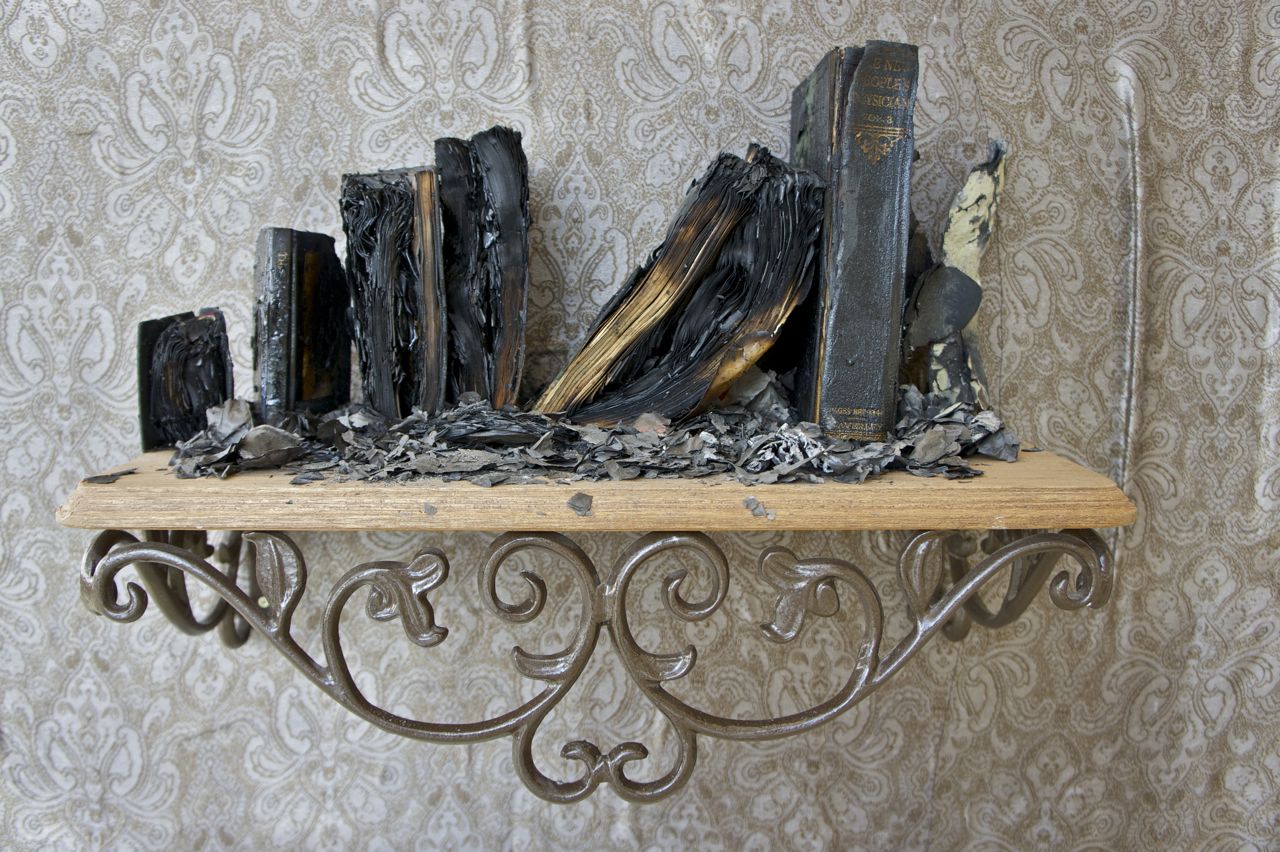
Huysmans books are full of retreats – exploring solitude, the yearning individual in a valueless world. He attempted a book that would banish that world. Central to the book is one decadent character referred to above. As an author Huysmans had a passion for reproducing and commissioning copies and more importantly he had a fine collection of finely bound books. He is a bibliophile – lover of book as object, overcomes the reader. The hero in his novel does not read, instead he is obsessed about the paper quality and the bindings.
Installation of Artists Books by Penny Payne.
Exhibited at FADA Gallery last week.
 2012 B Tech Visual Arts student.
In the context of my anticipated artists book, it is important to note that we live in a digital era, the impact of digital technology and other key influences are changing our environment in which information is sourced, processed and distributed. We therefore need to ask - will digital media change the dynamics of the book from an object, which is bound by a beginning, middle and an end? Tablets have also had a stronger negative impact on the market for hard copy magazines and books. 
The paradox referred to in the opening paragraph of this blog post (with reference to social media) can also be applied to the dissemination of information in the future – when we wish to read do we connect or disconnect with hardcopy in hand for the couch. The following study conducted in Australia anticipates the transformation of accessing and the dissemination of information, as we know it.


Installation of artists books by Penny Payne.
FADA B Tech Visual Arts Student.
2012 yearend exhibition.
Book as a cultural concept’ (cluster 1), ‘generational change’ (cluster 4) and ‘eBook and digital technology’ (cluster 5) have been used to identify the vertical axis for the matrix.  This looks at the way the cultural concept of the book is changing from traditional formats at the bottom of the axis to the transformative formats at the top. The workshops showed great interest in the potential for the book to be transformed in the future by the fluidity of its boundaries in a digital environment. The changes being seen include the way multi-media platforms may change the book’s content from traditional textual material supported by illustrations to a textual content that is ever-changing and supported by audio, video and content that is co-created by users in collaboration with authors and publishers. This axis therefore, addresses the significant uncertainties relating to the adoption of new technology and its transformative power – driven by generational change, the social media and the future of reading, which – among other things – may change the way consumers engage with books in their many different formats. An extract from a publication of an Authors and agents workshop held in February of 2011 in Australia.

The installation of artists books featured here is the work of Penny Payne, a B Tech student at the university of Johannesburg - exhibited at the FADA Gallery last week. The Cube installation represents the balance of the body, mind and soul. The tablets for each wall is intellect, psyche  and spirit.  Text from the artist's Statement at the exhibition.
Each wall has been created around specific experiences remembrances, discovery of identity and anxieties.  The book as an object becomes a symbolic format not only in being a container for stories but distorting and disfiguring the book to form a narrative itself. 
I use books frames and boxes to create pieces which portray a growth and an understanding of self and the struggle to find identity by transforming books from the past and constructing them into symbols and metaphoric images. The construction of this wall, with its infestation of book art, channels the search for my identity.